Sketching My Life At Home: A Feminist Visual Art Practice
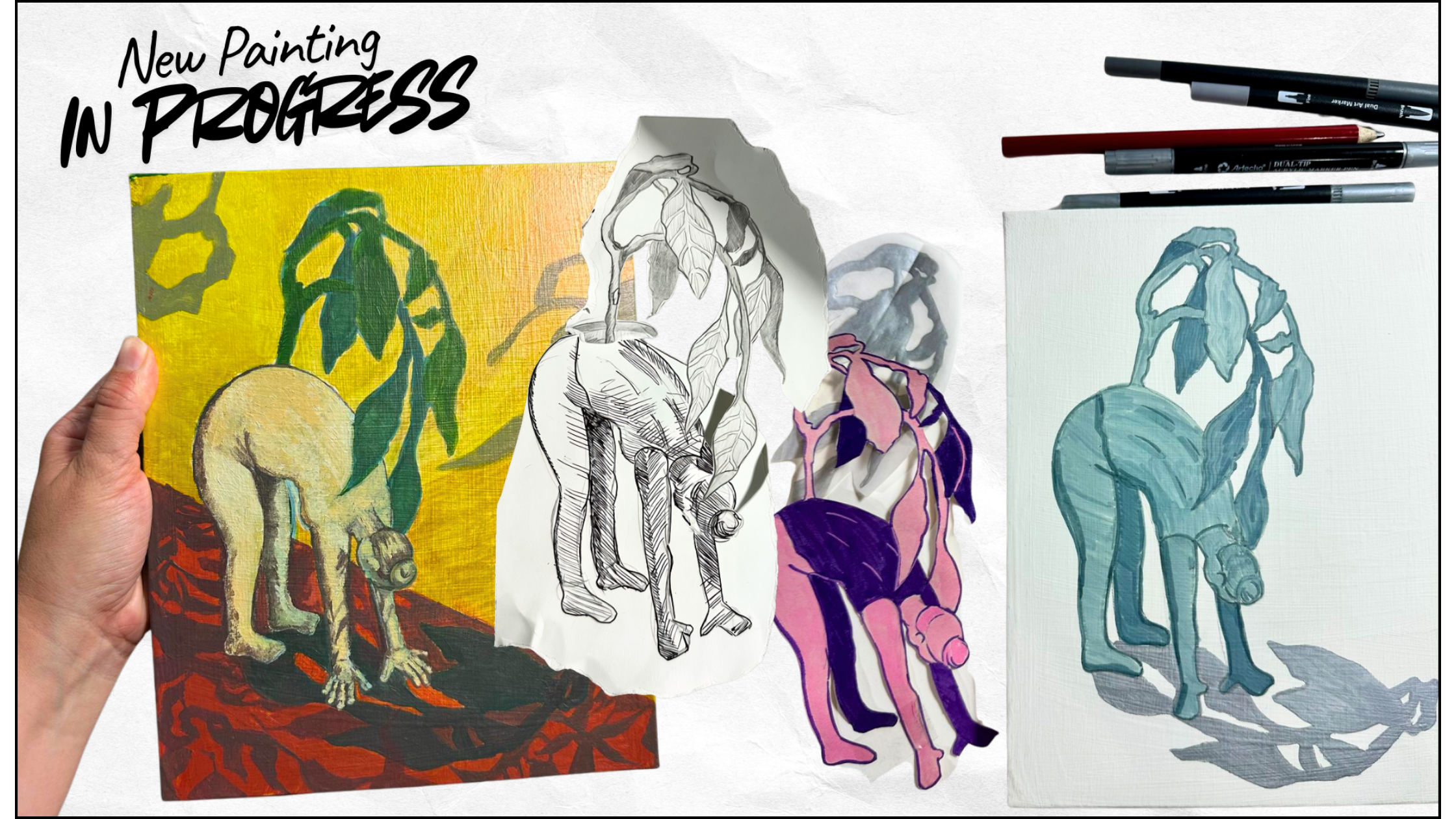
Today I noticed the gesture of my dying houseplant and how it matched my energy when I’m in a forward fold in yoga class. The vibe is “Okay, I accept this is happening… I literally fold”.
There is a point in the creative process when the art has not yet fully become itself...
It is not a finished painting.
It is not a polished series.
It is not ready to be framed, titled, priced, photographed, or explained.
It is still a thought.
A feeling.
A symbol.
A strange little image that keeps returning.
For me, this new work is beginning at my new home in Welland, Ontario.
Not in a dramatic or cinematic way, or in a perfectly curated studio scene with beautiful lighting and evidence of artistic genius surrounding me…shout out to my friends in my last shared studio space at The Cotton Factory in Hamilton. I miss you guys.
How It Begins, Again
It begins with ordinary things.
A laundry basket, a yoga mat, folded towels, and a slightly dying houseplant all in a home that desperately needs to be cleaned, again.
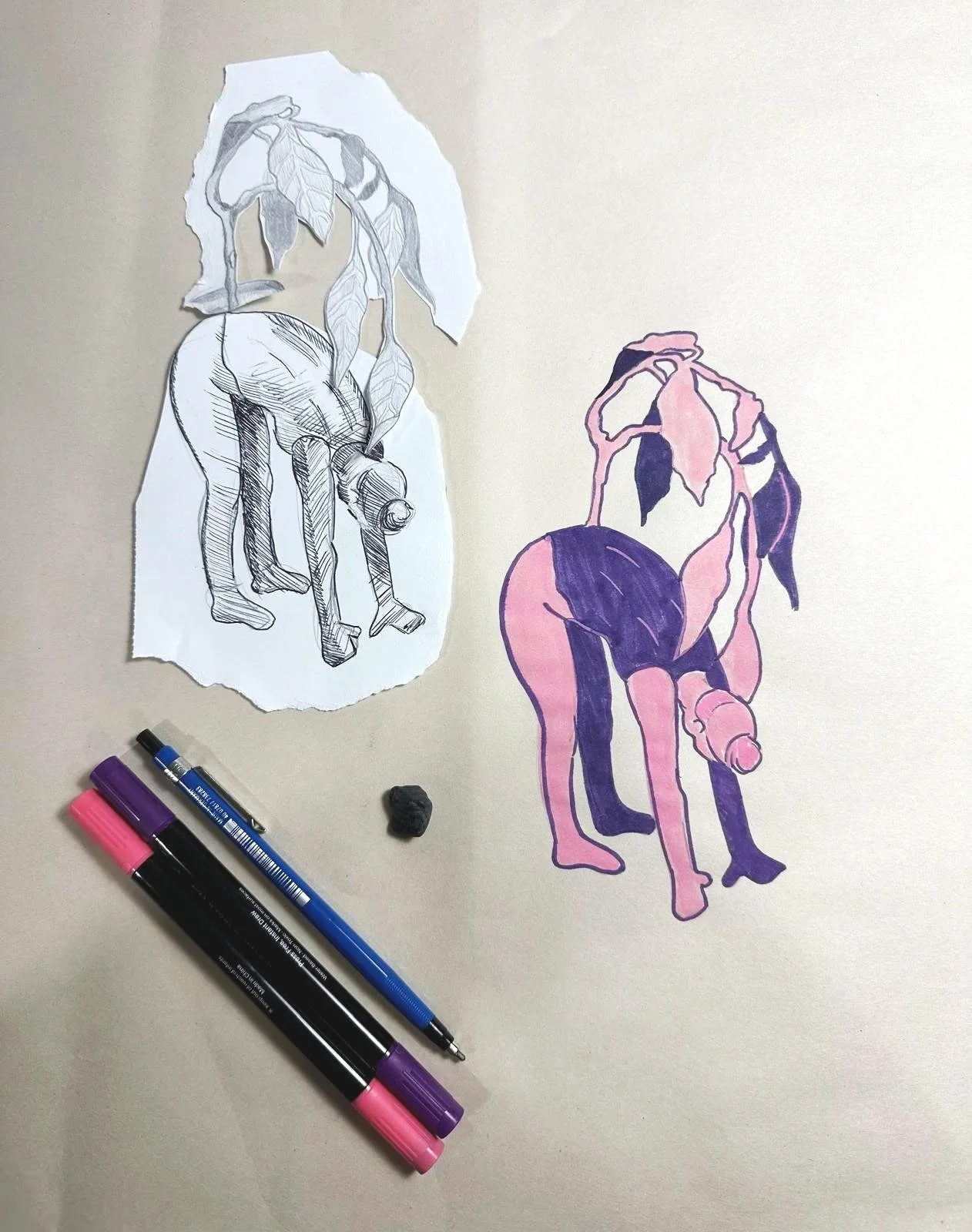
A look into my art practice. From digital concept, to quick sketches, to cutting and re-arranging.
It also begins with a sketchbook waiting for me to stop overthinking and doodle something ridiculous just because I can.
This is where my feminist visual art practice is asking me to pay attention: to the life I am actually living, not the idealized version of life I keep thinking I need before I can make serious work.
All Art Begins With Noticing
I have been thinking about how much art begins with the act of noticing.
Noticing what has been dismissed.
Noticing what has been made invisible.
Noticing whose labour is considered natural, expected, or unimportant.
Noticing how the body carries memory, pressure, care, and survival.
Feminist art has often challenged the traditional art world by asking different questions. Who gets represented? Who gets remembered? Who gets called important? Whose body is being looked at, and who gets to do the looking?
In feminist art history, artists have used the female body, domestic materials, performance art, video art, textiles, installation, and conceptual art to challenge conventional ideas about women’s experiences. Much feminist art asks us to reconsider what counts as serious subject matter.
That is part of what interests me right now.
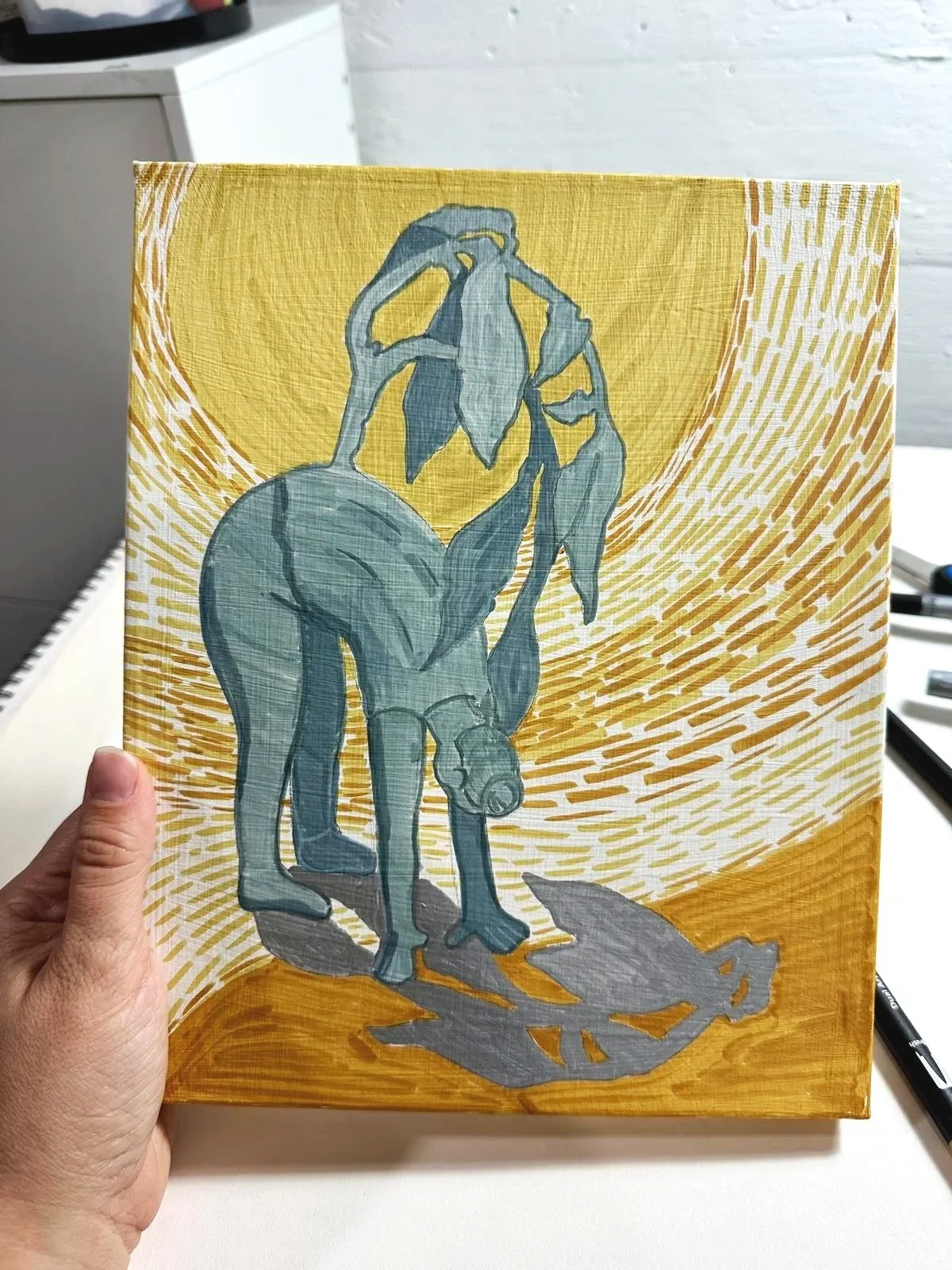
Painting progress
The home is not neutral.
The body is not neutral.
A domestic object can become a symbol.
A repeated chore can become a visual rhythm.
The Female Body Inside Domestic Space
The female body is central to this new work, but not as an object for display.
I am interested in the body as a place of return.
The body bending.
The body reaching.
The body folded over.
The body carrying.
The body resting.
The body trying to feel at home in itself again.
This is where the work connects to feminist perspectives around the body and the gaze. Feminist artists have long challenged the male gaze by asking what happens when women represent themselves, their own bodies, their own labour, and their own inner lives from the inside out.
I am not interested in making the body look perfect.
I am interested in what the body knows and how long it takes for the brain and heart to catch up.
A female body posing on a yoga mat at home can become a symbol of care work, domestic responsibility, and the invisible weight of keeping a life together. A body beside a plant can become a reminder that living things need tending.
Feminist Art History Without Losing My Own Voice
I know this work sits inside a much larger history.
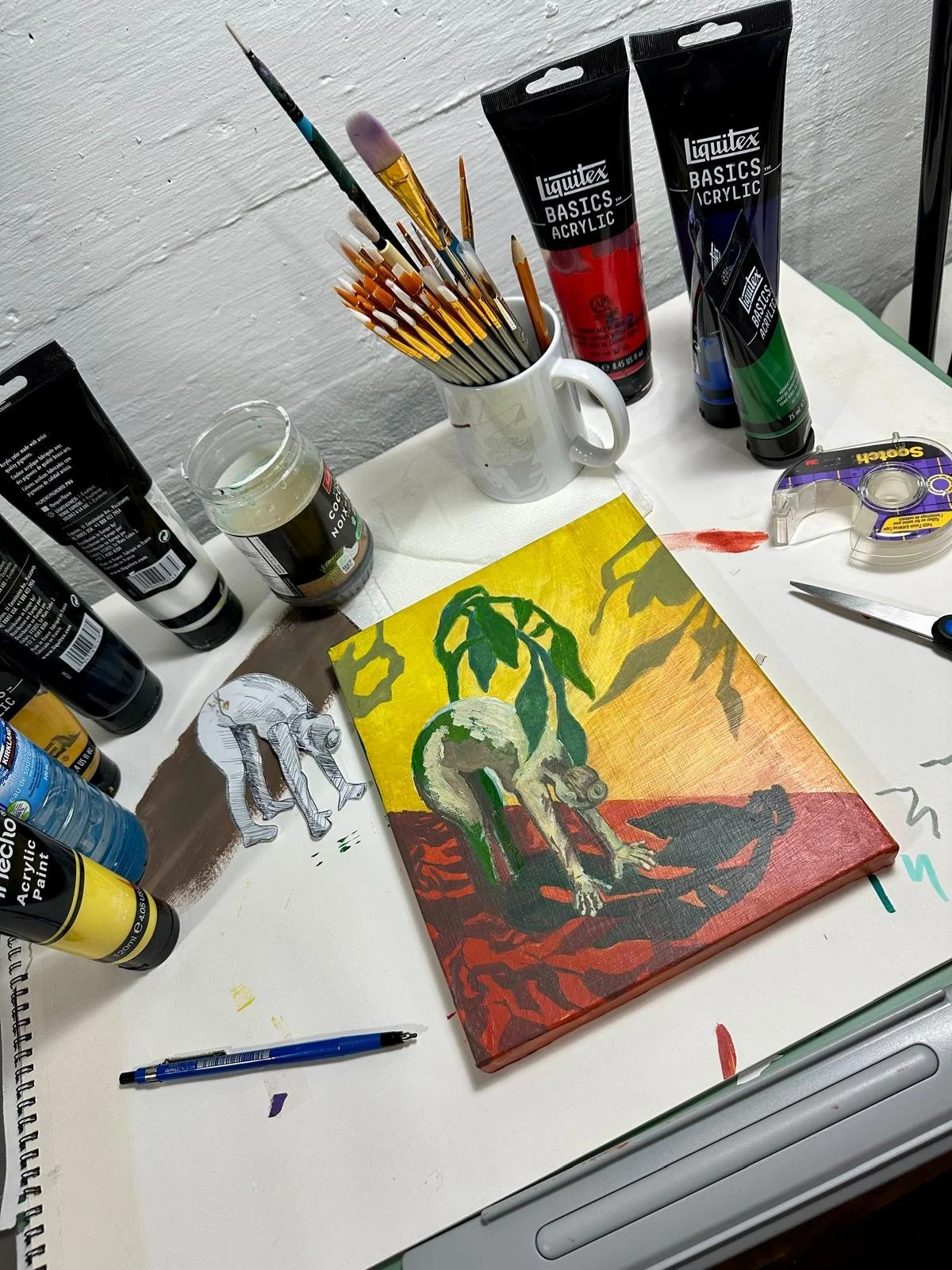
A very small painting in progress
Feminist art emerged strongly in the late 1960s and 1970s alongside second-wave feminism. Artists began using their own bodies, domestic materials, performance, installation, video, and conceptual strategies to critique gender inequality, patriarchal society, and the erasure of women artists from museums and galleries.
Artists like Judy Chicago, Miriam Schapiro, Ana Mendieta, Cindy Sherman, Barbara Kruger, Carolee Schneemann, and the Guerrilla Girls helped expand what feminist art could look like, say, and challenge.
But I do not want to write this post as though I am standing outside that history giving a lecture.
I am inside my own studio, trying to understand why a laundry basket, a yoga mat, and a body in motion feel like the beginning of something.
That is the point.
Feminist art history gives me context. My own life gives me material. The sketchbook gives me a place to begin. I don’t need to start a protest in a major metropolitan city to make art that matters.
Making Art Before I Feel Ready
My art practice is not limited to finished paintings. It is made through attention. Through repetition. Through returning to the body. Through questioning what has been dismissed. Through letting ordinary life become visual culture.
I am trying to stop waiting for the perfect version of myself before I make the work. All I have is today.
So, I am sketching the life I am learning to live.